

All products

115E-2 Ethernet Networking I/O and IoT Gateway
Compact Ethernet I/O and IoT Gateway connected to an Ethernet interface for remote monitoring.

215U-2 WiFi IoT I/O Gateway
The Elpro 215U-2 now supports MQTT with SparkplugB. This takes a huge step forward in enabling UHF telemetry devices to make use of exciting IIoT functionality.
The 215U-2 configuration is quick and easy using built-in Webbased tool either directly at the unit or over the air, which also provides comprehensive diagnostic features.

415U-2-C4 Wireless IoT I/O Gateway
The Elpro 415U-2-C4 now supports MQTT with SparkplugB. This takes a huge step forward in enabling UHF telemetry devices to make use of the exciting IIoT functionality.
The 400MHz radio will be used as a long range scalable industrial wireless gateway & I/O module for reliable & secure connectivity to outstations.
Integration to PLC & SCADA is done seamlessly via Modbus TCP/RTU. This can be achieved without the use of third party drivers or OPC to most SCADA systems & PLC’s.

415U-E-C4 Wireless IoT I/O Gateway
The Elpro 415U-E-C4 now supports MQTT with SparkplugB. This takes a huge step forward in enabling UHF telemetry devices to make use of the exciting IIoT functionality.
The 400MHz radio will be used as a long range scalable industrial wireless gateway & I/O module for reliable & secure connectivity to outstations.
Integration to PLC & SCADA is done seamlessly via Modbus TCP/RTU, DNP3 or MQTT. This can be achieved without the use of third party drivers or OPC to most SCADA systems & PLC’s.

645M-4 4G/LTE Cellular WiFi modem and router
The ELPRO 645M-4 is today’s leading solution for enabling your devices to the Internet of Things (IoT) and Industrie 4.0. Secure connectivity of your devices has never been so important in today’s industrial world.
Elpro 115S Serial Expansion (Remote I/O)
Connected via RS485 and communicating either Elpro or Modbus protocols, Elpro’s 115S series expansion products are avialable in three versions of I/O count.
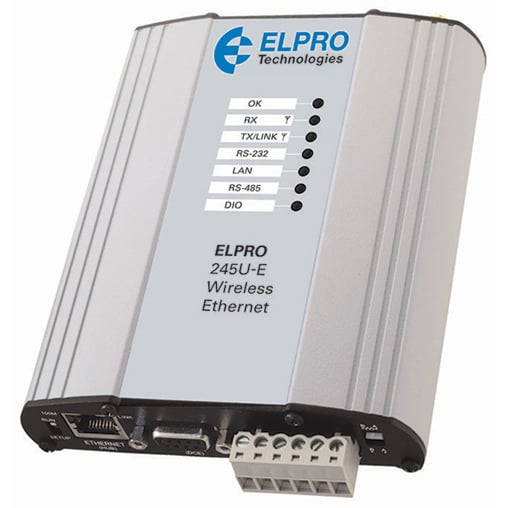
Elpro 245U-E-G/A: Wireless High-Speed Ethernet Modem
The ELPRO 245U-E Wireless Ethernet Modem is a robust, license-free wireless 802.11 standards compliant transceiver capable of high bandwidth communications.

Elpro 415U-1-C4
The new Elpro 415U-1-C4 is a RTU with UHF radio built in that consumes very little power. The unit has a range of up to 50km when used in the licensed band and it will consume 100uA in idle mode.

Elpro 455U High Performance Modem
Wireless serial modems allow RS232 and/or RS485 serial host devices to communicate transparently. Messages are routed between devices as broadcast or controlled mode.

Elpro 641M 4G-LTE Router
Cellular 4G-LTE router for IOT and Gateway applications. The ELPRO 641M is targeted at enabling your devices to access the Internet of Things (IoT) and Industry 4.0.

Point Green 3G
Point Green is a compact Logger/RTU device with integrated battery, a 3G modem with GPRS fallback, internal and/or external antenna, digital and counter inputs, Modbus and SDI-12 master capability and a submersion sensor.

Point Orange 3G : RTU outstation
Point Orange is a compact Logger/RTU device with integrated battery, a 3G modem with GPRS fallback, internal and/or external antenna, flexible I/O options, Modbus and SDI-12 master capability and a submersion sensor.

Point Orange IoT Logger
IP68 rated, low powered Remote Telemetry Unit with software configurable I/O.


